low end tidal co2 during cpr
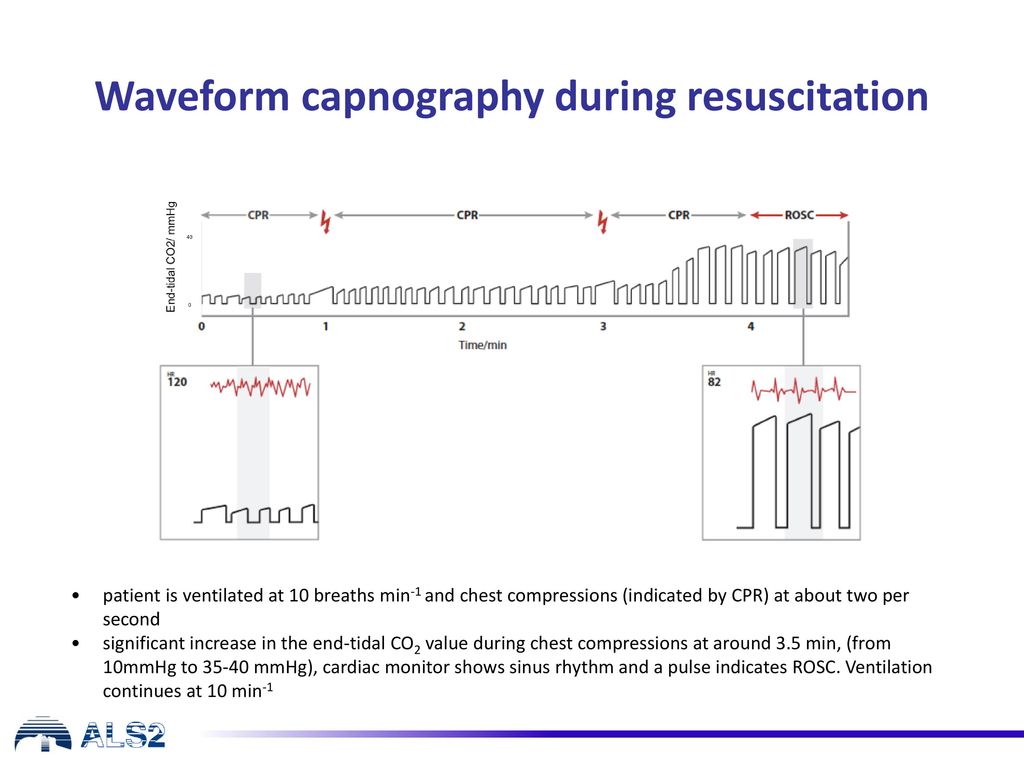
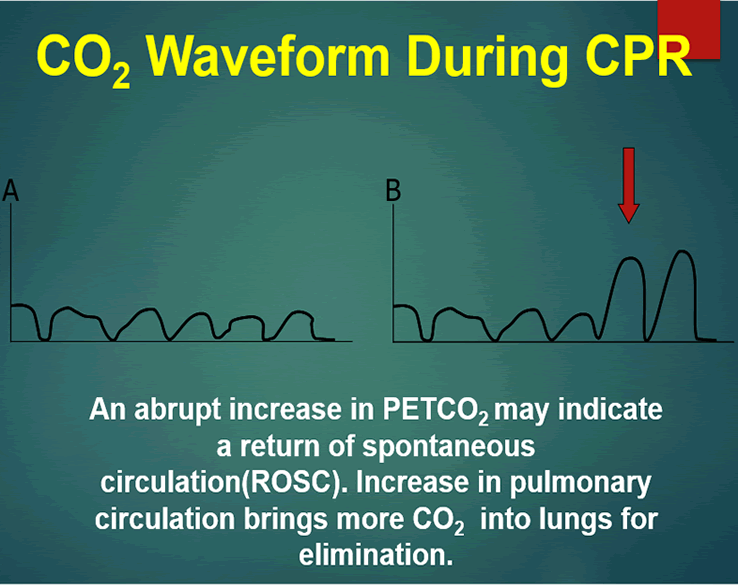
The first sign of the return of spontaneous circulation ROSC during CPR is increase in ETCO2. A rapid rise in EtCO 2 during CPR can indicate ROSC due to the improved oxygen delivery to tissues that were compromised during cardiac arrest.

Average Etco2 Kpa During Cpr In Patients With Or Without Rosc Download Scientific Diagram
Rounded low rectangle EtCO 2 waveform during CPR with a high spike on ROSC.

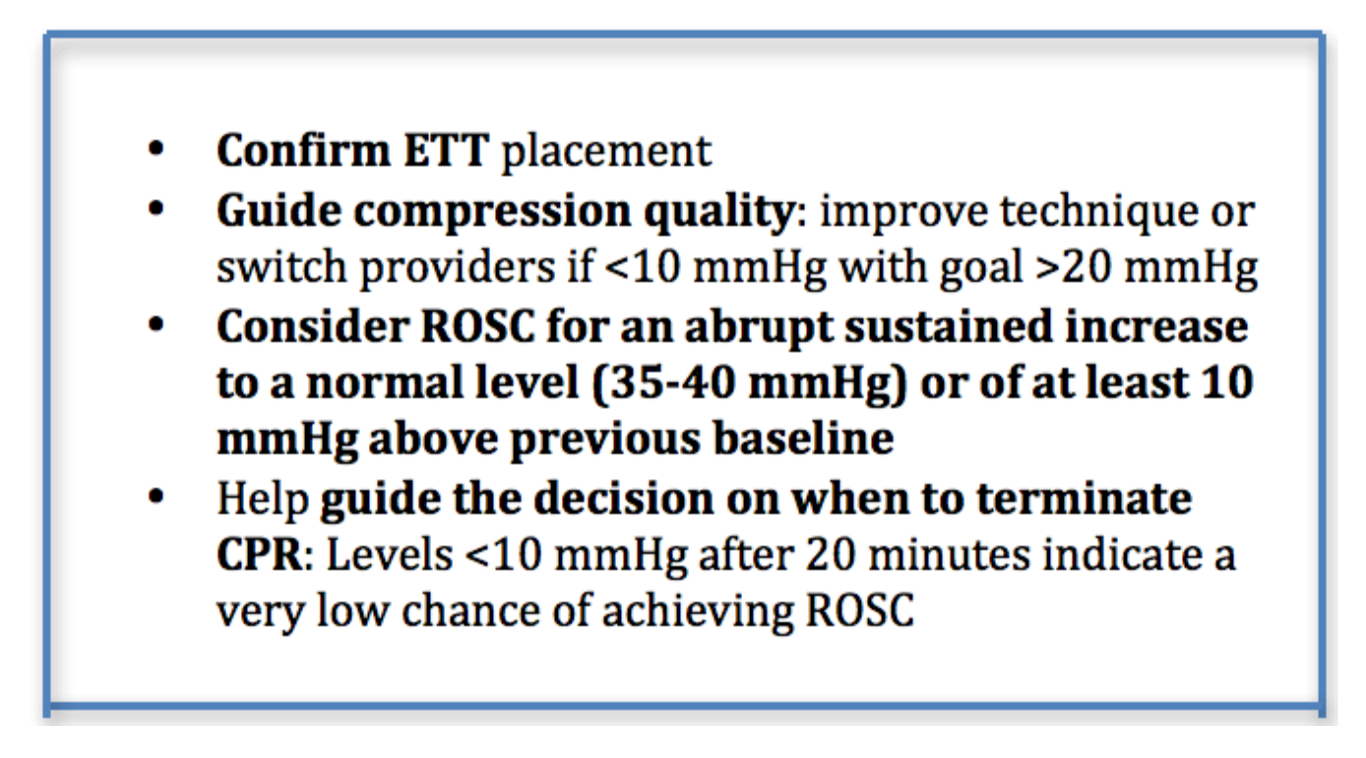
. Evaluating the effectiveness of chest compressions is accomplished in the following manner. Measuring end-tidal CO2 in cardiac arrest patients is helpful for confirming tracheal tube placement assessing the effectiveness of chest compressions predicting likelihood of return of spontaneous circulation ROSC in that a persistently low ETCO2 tends to predict death whereas a high or rising ETCO2 is associated with a higher chance of ROSC. Low ETCO2 below 10 mm HG may be caused by either poor compression technique or from low perfusion and metabolism after a long downtime or shock despite good compressions.
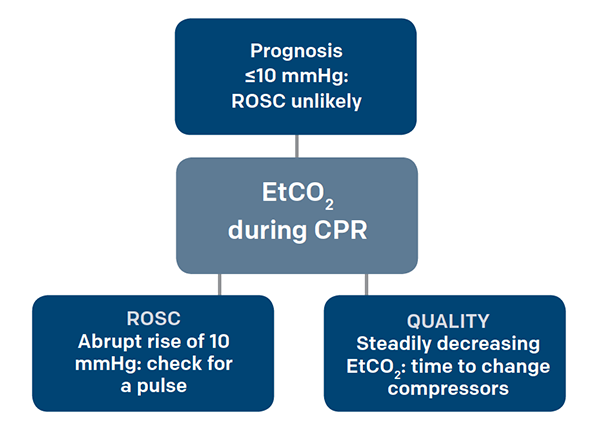
Measurement of a low ETCO 2 value 10 mmHg during CPR in an intubated patient suggests that the quality of chest compressions needs improvement. 10 to 20 mmHg during CPR was strongly associated with ROSC while persistent EtCO2 below 10 to 20 mmHg after 20 minutes of CPR had a 05 likelihood of ROSC. Total pressure of a gas is the sum of the partial pressures of the gas Expired CO2 measured PetCO2 mmHg in waveform Percentage Normal Levels PaO2 85-100mmHg PaCO2 35-45mmHg Percentage vs.
The normal values are 5 to 6 CO2 which is equivalent to 35-45 mmHg. Current guidance recommends an end- tidal carbon dioxide ETCO2 of 4045 kPa 300 338 mm Hg to achieve a low- normal arterial partial pressure of CO2 PaCO2 and reduce secondary brain injury. High quality CPR consistent waveform and end-tidal CO2 20 kPa.
What does end-tidal CO2 tell you. Patient end-tidal carbon dioxide. Throughout the resuscitation end-tidal CO 2 was consistently in the 28-36 mmHg range during VFCPR.
Ensure proper rate approximately 100min Ensure proper depth with adequate releaserecoil of thorax 12 thorax or minimum 25 inches Persistently low EtCO. 78 Nitrogen 21 Oxygen 1 CO2 and other gases Exhaled gases. Adequate excellent hard-and-fast CPR will produce ETCO2 levels that are closer to normal 20 to 30-ish while lack of CPR or really bad CPR will produce ETCO2 levels that are practically nonexistent.
We compared ETCO2-directed chest compressions with chest compressions optimized to pediatric basic life support guidelines in an infant swine model to. 11172009 4 Measuring End Tidal CO2 Daltons Law. Evidence suggests a persistently low ETco 2 value and a widened Paco 2-to-ETco 2 gradient during CPR are associated with poor outcomes.
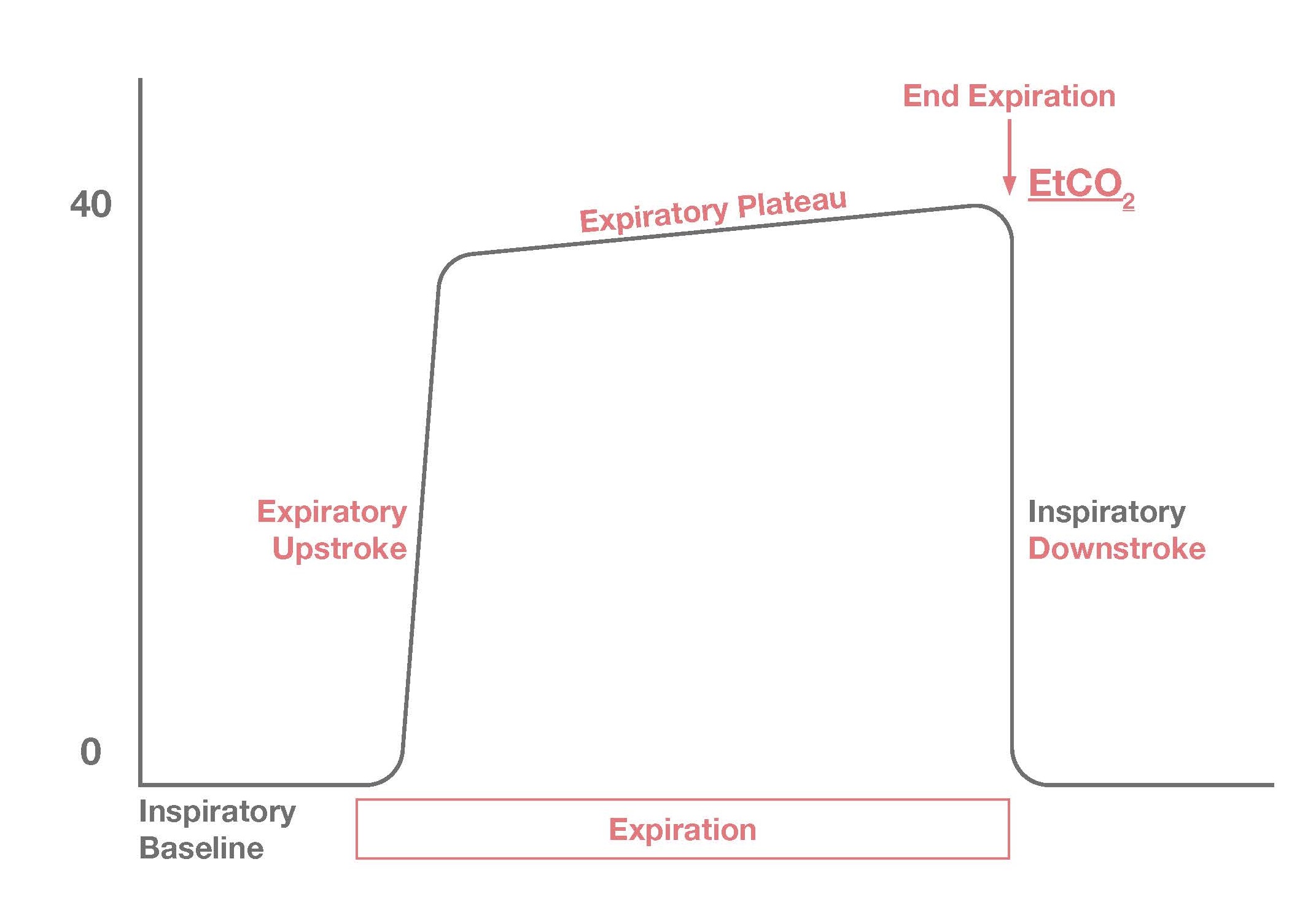
Measurement of a low ETCO2 value 10 mmHg during CPR in an. Continuous Waveform Capnograpy is written as PETCO2 which stands for patient end-tidal carbon dioxide. End-tidal carbon dioxide ETco2 monitoring provides valuable information about CO2 production and clearance ventilation.
A sustained drop or low. Ok now we get to the absolutely coolest thing you can use ETCO2 and capnography forCPR. End-tidal carbon dioxide.
1 evaluating the effectiveness of chest compressions and 2 identification of ROSC. What Should End Tidal Co2 Be During Cpr. What are the origins of these numbers.
By measuring exhaled CO2 many types of pulmonary assessments can be made. The normal EtCO2 level is about 14 and the ideal CPR will provide at least 14 of the cardiac output. Two very practical uses of waveform capnography in CPR are.
Uses during cardiac arrest. End-tidal CO2 EtCO2 monitoring is a noninvasive technique which measures the partial pressure or maximal concentration of carbon dioxide CO2 at the end of an exhaled breath which is expressed as a percentage of CO2 or mmHg. Goal is 10 mmHg during CPR.
End-tidal carbon dioxide cannot be used to rule out severe injury in patients meeting the criteria for trauma care. End-tidal carbon dioxide ETCO2 correlates with systemic blood flow and resuscitation rate during cardiopulmonary resuscitation CPR and may potentially direct chest compression performance. Expect it to be as high as 60 mmHg when ROSC is achieved.
Gradual fall in ETCO2 suggests compressionist fatigue during CPR - time to change compressionists. Thus ETco 2 monitoring is a noninvasive way to measure coronary artery blood flow and return of spontaneous circulation during CPR. Normal ETCO2 in the adult patient should be 35-45 mmHg.
Another use of ETco 2 monitoring is during procedural sedation and analgesia PSA. Chest compression provider tiring end-tidal CO2 value diminishes over time. A low P a CO2 level is correlated with increased risk of cerebral edema in children with DKA.
To identify whether any level of end-tidal carbon dioxide ETCO2 measured during cardiopulmonary resuscitation CPR correlates with return of spontaneous circulation ROSC or survival in adults experiencing cardiac arrest in any setting. The point is keeping an eye on your ETCO2 during. CPR is a method of capping.
We included randomized controlled trials cohort studies and case-control studies of adult cardiac. Why is ETCO2 low during CPR. Ideally teams should aim for EtCO2 levels of 10 mm Hg and ideally 20 mm Hg.
MmHg Relate to the air we breath. End-tidal carbon dioxide. Abrupt increase in ETCO2 suggests ROSC during CPR detectable before pulse check ETCO2 at 20 minutes of CPR is prognostically useful.
35-40 mm Hg PETCO2 less than 10 indicates ineffective chest compressions. 20 mmHg at 20 minutes CPR - higher chance of ROSC. These levels of CO 2 were consistent with effective chest compression generating reasonable pulmonary blood flow justifying continuation of resuscitation.

Graphic Recordings Of Aortic Pressure Aop Air Flow And End Tidal Download Scientific Diagram

Capnography During Cardiopulmonary Resuscitation Current Evidence And Future Directions
Waveform Capnography Version Jan Ppt Download

3 Waveform Capnography Showing Changes In The End Tidal Carbon Dioxide Download Scientific Diagram
Reversible Causes Of Low Etco2 In Cpr Criticalcarenow

Etco2 Valuable Vital Sign To Assess Perfusion The Airway Jedi

Average Etco2 Kpa During Cpr In Patients With Or Without Rosc Download Scientific Diagram

The Role Of Etco2 In Termination Of Resuscitation Jems Ems Emergency Medical Services Training Paramedic Emt News

Waveform Capnography In The Intubated Patient Emcrit Project

Capnography Provides Bigger Physiological Picture To Maximize Patient Care Jems Ems Emergency Medical Services Training Paramedic Emt News

3 Waveform Capnography Showing Changes In The End Tidal Carbon Dioxide Download Scientific Diagram

Waveform Capnography In The Intubated Patient Emcrit Project

Etco2 Valuable Vital Sign To Assess Perfusion The Airway Jedi
Emdocs Net Emergency Medicine Educationcapnography In The Ed Emdocs Net Emergency Medicine Education
Use End Tidal Capnography For Placing Orogastric Nasogastric Tubes And Cpr Page 2 Of 4 Acep Now Page 2

Capnography Provides Bigger Physiological Picture To Maximize Patient Care Jems Ems Emergency Medical Services Training Paramedic Emt News
Quantitative Waveform Capnography Acls Medical Training

The Impact Of Ventilation Rate On End Tidal Carbon Dioxide Level During Manual Cardiopulmonary Resuscitation Resuscitation
Cpr Mobile Code Stand With Capnograph Capnography
